A fast, lightweight implementation of the WFDB library and command-line tools, with identical behavior across seven programming languages
The documents shared by the seven implementations of WFDB-x. Each language has its own README, with installation, usage and its API: C++, Python, MATLAB/Octave, Rust, Julia, R, Kotlin. The project README is the starting point.
| Document | Contents |
|---|---|
| DIVERGENCES.md | The deliberate differences from the original WFDB Software Package, the reasons for each, and legacy mode, which reproduces the original exactly |
| KNOWN_C_BEHAVIORS.md | Surprising but well-defined behaviors of the C code that WFDB-x reproduces, and the behavior WFDB-x chose where the C code’s is undefined |
| INVENTORY.md | Every command-line tool and library function, with its status in each language |
| conformance.md | The conformance suite: how every implementation is checked against the original C programs, and how to run it |
| BENCHMARKS.md | Speed and memory use of the seven implementations, compared with wfdb-python and the original C tools, and how to read records fastest |
| porting-guide.md | The architecture of WFDB-x, and the C semantics that every implementation must reproduce |
| AUTHORS.md | The authors of the C code that each part of WFDB-x translates |
| RELEASING.md | How to release the Python package on PyPI: accounts, API tokens, TestPyPI and PyPI |
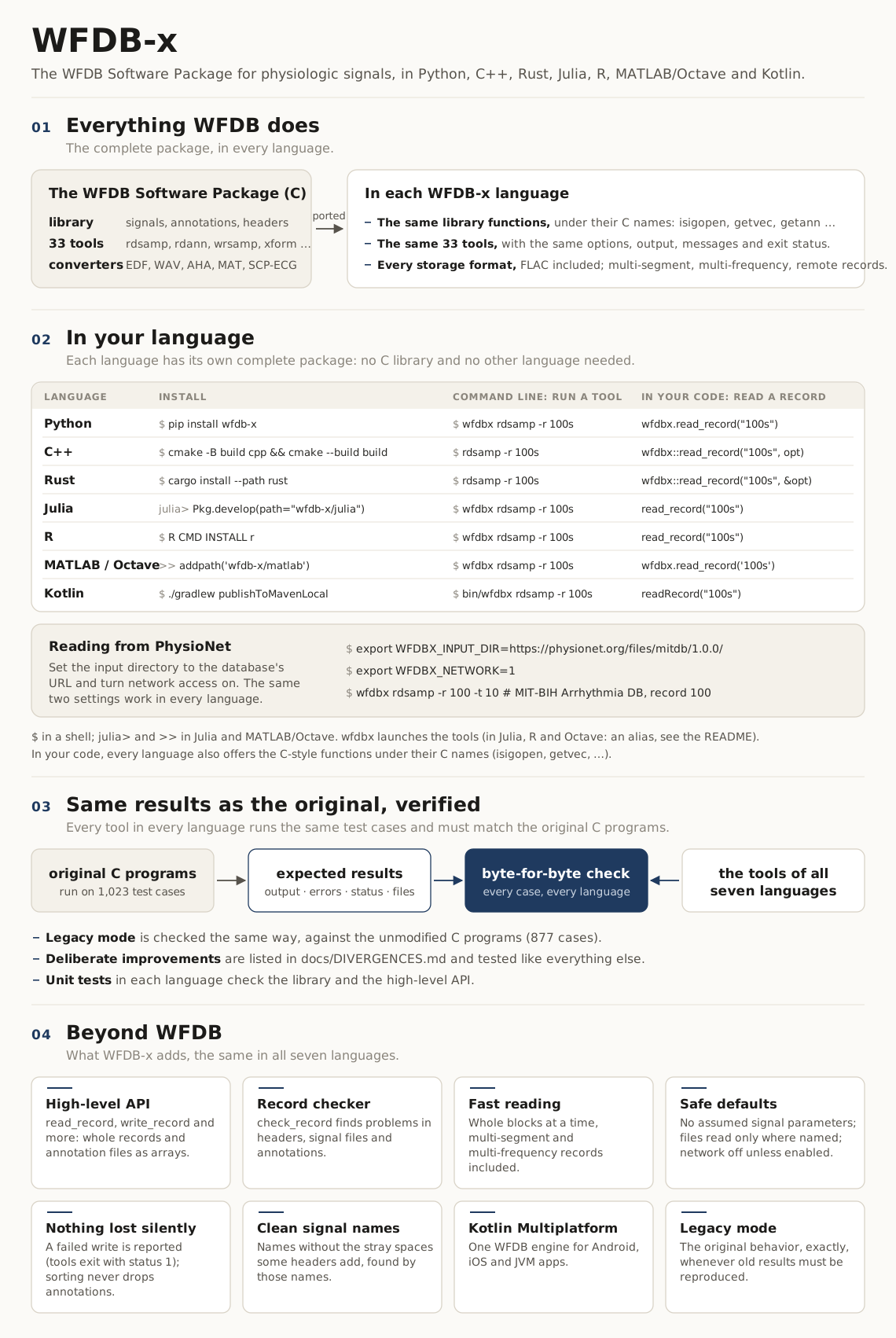
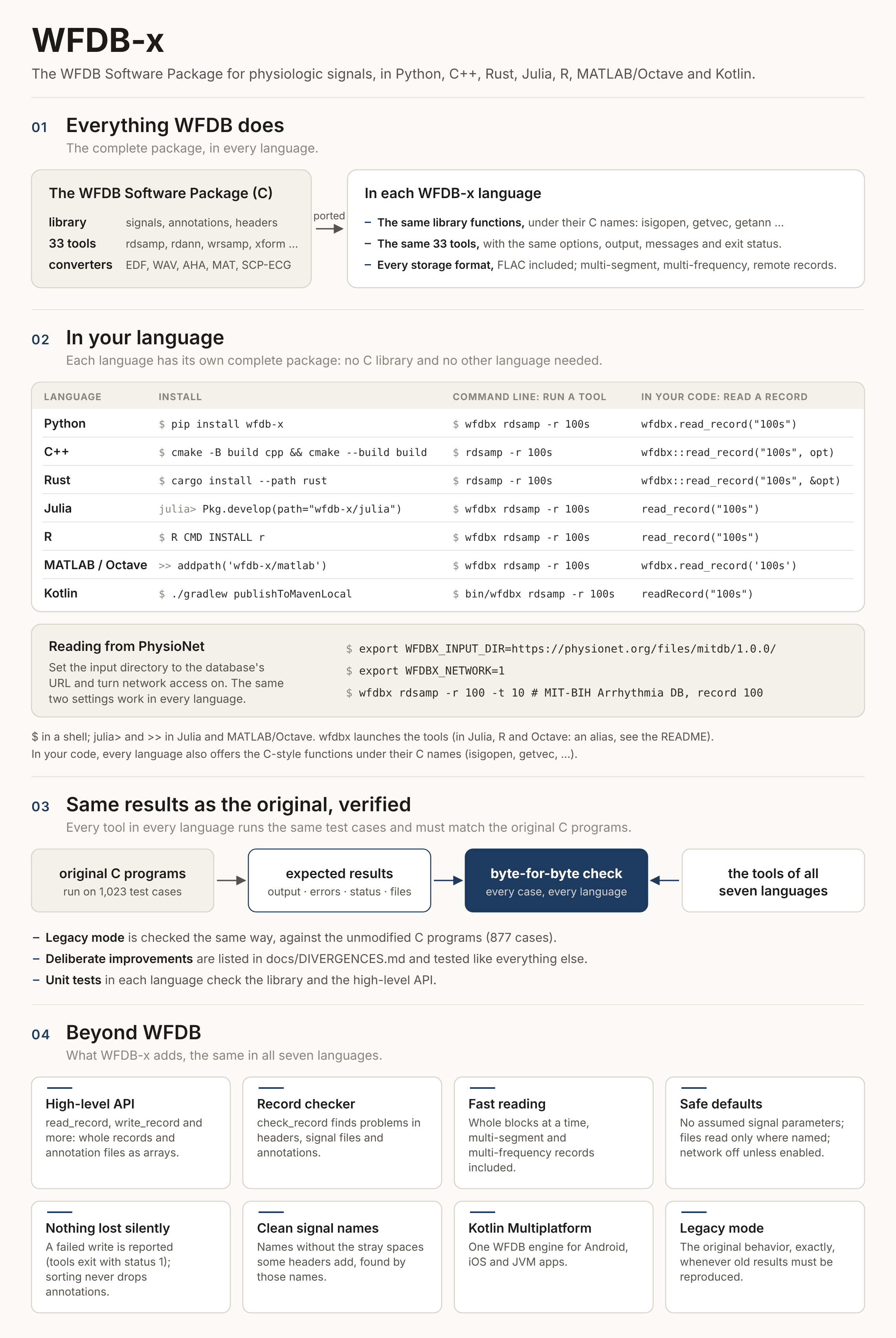
| overview.svg, overview.png | WFDB-x at a glance: the figure shown in the project README |
The tools and the library functions themselves are documented by the
original package’s manuals, which WFDB-x follows: the WFDB Applications
Guide (third_party/wag.pdf) and the WFDB Programmer’s
Guide (in third_party/wfdb-main.zip).